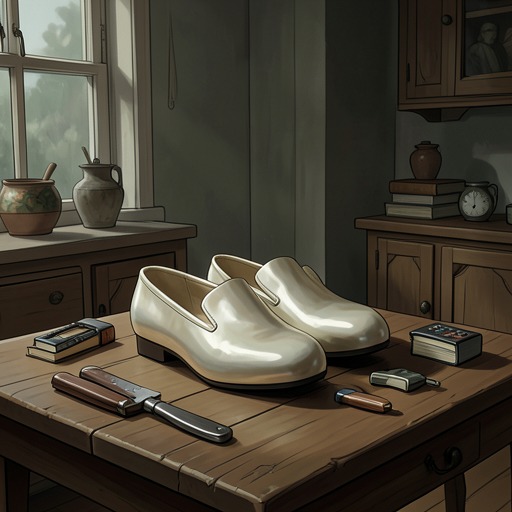
The crystal slipper
Grey BeesThe crystal slipper is a small drinking vessel from Sergey Sergeyich’s wedding to Vitalina, given to them by his former mother-in-law. In the midst of war, it becomes more than an unusual glass: Sergey Sergeyich offers it to a visiting soldier as a vessel for honey liquor, then protects it from casual use by his neighbor. Its changing place at the table makes private memory visible in the acts of hospitality and restraint that bind people together.
Identity and appearance
Sergey Sergeyich retrieves the slipper from an upper compartment of his sideboard when he offers Petro a drink. He describes it as a tiny crystal slipper and explains that he and Vitalina drank from it at their wedding; his former mother-in-law gave it to them. The object thus carries two layers of personal history: the marriage it commemorates and the gift through which another family relation entered that occasion.
The vessel is small enough to be treated as a novelty, but its form governs how Petro handles it. Sergey Sergeyich pours the guest’s measure into the slipper while taking an ordinary shot glass for himself. The yellow drink catches the light in the crystal. Petro wraps his fingers around the tall heel as though it were the stem of a wineglass, hesitates over which part should touch his lips, then tilts it until the liquid runs toward the heel. The narrative lingers on this careful improvisation, making the slipper’s unfamiliar shape part of the shared moment rather than a mere decorative detail.
A wedding keepsake at a wartime table
Sergey Sergeyich’s offer of the slipper accompanies a toast to the end of the war. Petro checks that this is what his host means, then accepts the toast and drinks slowly. The sweet taste is honey: the same substance Sergey Sergeyich’s life and work are organized around, here served not as a saleable product but as hospitality. The precious wedding vessel and the beekeeper’s honey meet in a modest domestic ritual, while the toast names the violent circumstances beyond the table.
That scene does not turn the slipper into a public emblem or erase its intimate associations. Sergey Sergeyich identifies it openly as a wedding gift even as he places it in the hands of a soldier he is hosting. The keepsake can be shared without being emptied of its history. Petro’s tentative way of drinking registers respect for an object whose use he has not been taught, while Sergey Sergeyich’s gesture makes the guest welcome inside a household marked by a marriage that remains part of his remembered life.
Refusal and the boundary of ordinary use
The slipper’s significance becomes clearer when Pashka later proposes that Sergey Sergeyich give it to their guest for amusement. Sergey Sergeyich’s look immediately wipes the sly grin from his neighbor’s face. He refuses: they will not use that vessel, because it was a wedding gift. The contrast is sharp. For Petro, the slipper is offered within a serious toast and handled with care; Pashka suggests it as a joke, and Sergey Sergeyich draws a boundary around it.
The refusal does not contradict the earlier offer. The object is not untouchable: it has served a guest on an occasion Sergey Sergeyich chose. What he rejects is treating it as an amusing prop. His response distinguishes hospitality from careless familiarity and shows that the slipper’s meaning depends on the circumstances in which it is used. Its place in the sideboard, its wedding history, and its exceptional use for Petro all belong to the same small domestic order.
Meaning through exchange and memory
Across these scenes, the slipper connects gift, marriage, guest-friendship, and honey without becoming interchangeable with any of them. Its origin is a family gift; its remembered use belongs to Sergey Sergeyich and Vitalina’s wedding; its wartime use gives Petro a measure of honey liquor; and its later refusal preserves the difference between a meaningful offering and a joke. The object’s value is therefore expressed through decisions about when to bring it out, whom to serve with it, and when to say no.
The crystal slipper also concentrates the book’s recurring attention to material acts of care. People offer food, honey, drink, and practical help under conditions shaped by war, and those exchanges create relationships that cannot be reduced to price. Here, the slow transfer of a sweet drink into an awkwardly shaped wedding keepsake gives a brief reprieve from the surrounding conflict without pretending the conflict has ended. Sergey Sergeyich’s toast is for a quick end to the war; the slipper preserves a more personal time, carrying a wedding memory into the present while remaining precious enough to defend.